STEM Mentorship & Coaching

FIRST LEGO League

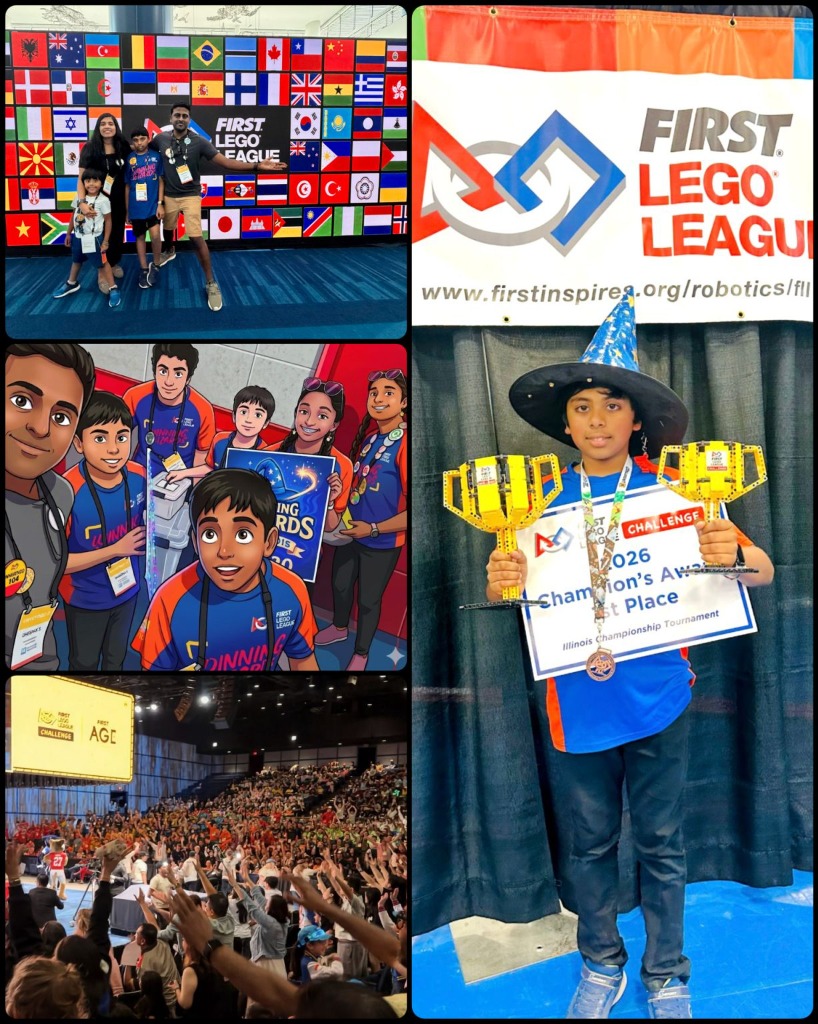
The Winning Wizards — FLL Robotics Championship

Mentoring and coaching a team of brilliant middle schoolers to 3rd in the Nation and 23rd Globally out of 35,000+ teams and 650,000+ students worldwide.
3rd Overall

In the United States

Achieved 3rd place nationwide at the World Championship in Houston.

23rd Global

World Championship

Ranked top 23 globally out of 35,000+ competing teams across 77 countries.

Undefeated

Road to Houston

Champions at Regional Qualifiers, Sectionals, and the State of Illinois.

The Winning Wizards Robotics Team Championship Collage
FIRST LEGO League • UNEARTHED Season

A Season of Innovation, Strategy & Championship Grit

As a parent and team mentor, it has been a profound privilege to help guide these brilliant kids through months of intense software architecture, mechanical prototyping, and high-pressure tournament strategy.

From winning 1st Place at the Illinois State Championship to competing alongside the world's best in Houston, the Winning Wizards proved that curiosity, tenacity, and teamwork overcome any challenge.

State Champions3rd in Nation23rd GloballyTerraQuest Rover

The Three Engineering Pillars

Innovation Project: TerraQuest

The team engineered TerraQuest—a sophisticated rover + drone prototype powered by a Raspberry Pi that uses onboard environmental sensors to calculate terrain safety and archaeological worthiness scores.

To solve real-world industry nuances, the kids interviewed archaeologists, university professors, and robotics executives globally, incorporating cutting-edge sensor analysis directly into their hardware.

High-Stakes Robot Game

Executing autonomous robotics mission routines under high-pressure 2.5-minute match timers.

The students programmed multi-attachment motorized mechanisms, precision line-following color sensor loops, and gyroscopic turns to maximize score density across complex mission runs.

Robot Design & Architecture

Presenting full software architecture, modular mechanical attachments, and sensor data pipelines to panels of industry judges.

Students defended their code structures, error-handling routines, and iterative engineering design logs with professional rigor.

Why Teach Kids to Code in the Age of Generative AI?

In a world where AI effortlessly generates syntax, the robot field reminds us that the physical world demands an entirely different layer of mastery.

Generative AI tools operate in an idealized digital sandbox—they don’t experience the friction under a robot’s tires, the mechanical torque of a gear train, battery voltage sag, or how an attachment’s center-of-mass alters a high-speed turn angle. Overcoming these mechanical variables required the kids to engineer adaptive code that bridges the gap between digital logic and physical reality.

Just as calculators didn’t eliminate the need to learn mathematics, generative AI doesn’t replace foundational engineering intuition. By programming microcontrollers, reading live telemetry, and understanding core system architecture, these kids aren’t just learning a curriculum—they are training their minds to solve complex, structural challenges where code directly commands the physical world.